
Most big roof leaks start as small problems that nobody noticed. At In-Ex Designs Roofing, we want Phoenix homeowners to catch those problems early. This guide covers what to look for on tile, flat or low-slope, and shingle roofs, and why the Valley’s heat, UV and monsoon storms affect each type differently.
The short version: if you can see a warning sign, get the roof inspected before the next storm.
Sound Familiar?
These are some of the things we hear most often from Phoenix-area homeowners and business owners. If one of them sounds like you, jump to the section that fits:
- “My roof is really old, I need to get it checked out.” See why roofs fail in Phoenix and how long tile underlayment lasts.
- “There’s a stain on my ceiling.” See signs you can spot from inside.
- “My roof leaked during the last storm.” See tile roof warning signs and inspect before the next storm.
- “I’m not sure when my roof was last inspected.” See how often a roof should be inspected.
On this page: why roofs fail · tile roofs · flat and low-slope roofs · shingle roofs · signs from inside · warning signs at a glance · FAQ
Why Roofs Fail in Phoenix
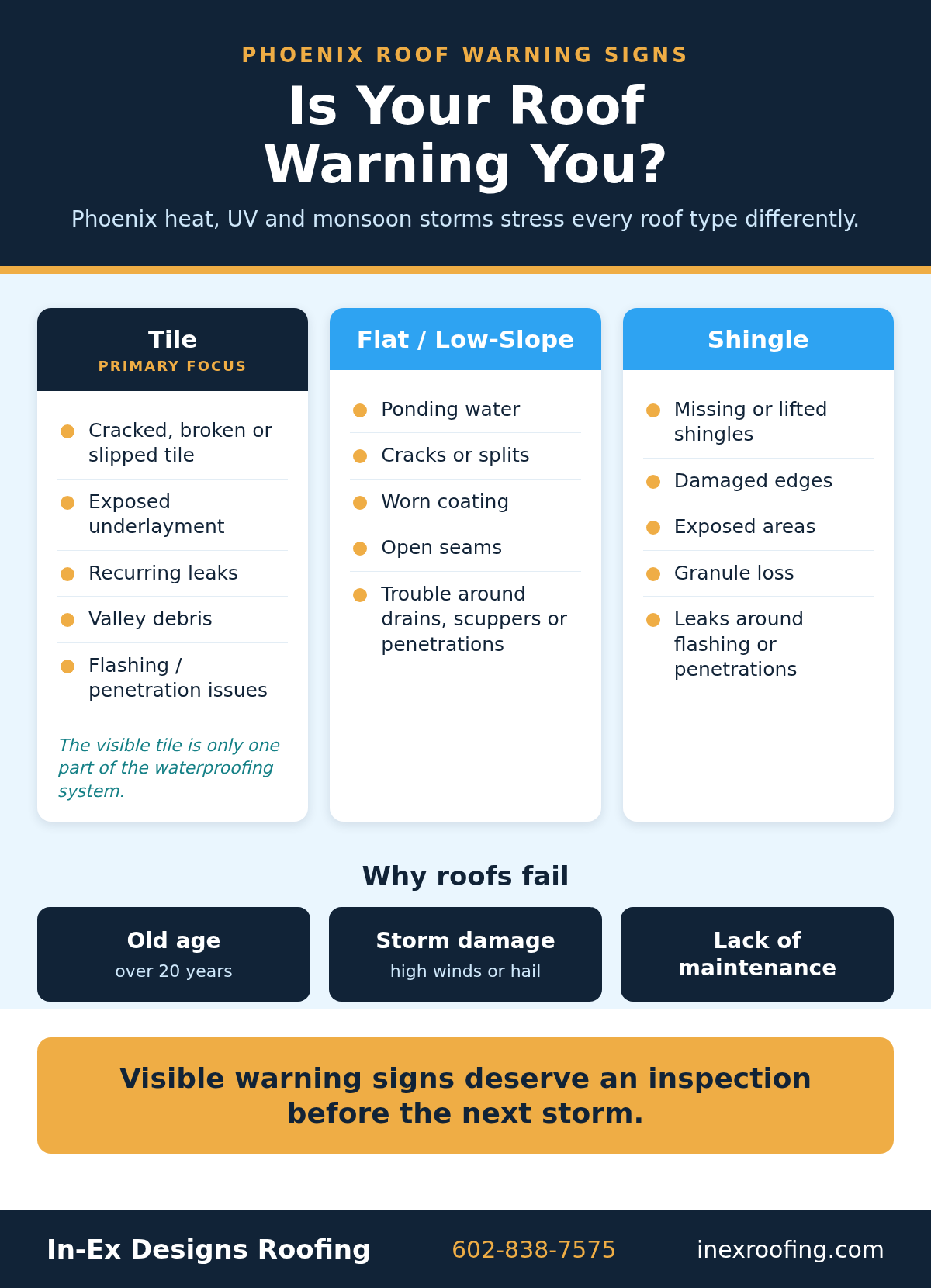
When we inspect roofs around the Valley, most failures come back to three causes: old age, storm damage and lack of maintenance.
Old age (over 20 years). Materials wear out as they age, and the parts you can’t see often go first.
Storm damage (high winds or hail). The National Weather Service defines the Southwest monsoon as June 15 through September 30. Phoenix issues a Severe Thunderstorm Warning when a storm produces gusts of at least 58 mph and/or hail at least 1 inch across.[2][3] Even in 2024, a dry monsoon year, NWS Phoenix recorded microbursts on July 24 and a downburst on August 6 that caused wind damage in the metro.[4]
Lack of maintenance. Valleys full of debris, clogged drains and old sealant let small issues grow.
Phoenix heat is getting harder on roofs
Phoenix Sky Harbor recorded 70 days at or above 110°F in 2024, the most on record. The 1991–2020 average was 21 days, and the last 110°F day of 2024 came on October 7, the latest on record.[5] Longer heat seasons mean roofing materials spend more time under high temperatures and UV. (For more on this, see our post on Arizona roof heat damage.)
Tile Roofs: Our Primary Focus
The visible tile is only one part of the waterproofing system. Concrete and clay tiles shed most of the water. Underneath them, the underlayment, flashings and other components keep water out of the house. The Tile Roofing Institute’s installation guide lists those components as part of the system: underlayment, battens, bird stops at the eaves, valley flashing, wall pans, headwall flashing and pipe flashing.[6] That’s why a tile roof can leak even when the tiles look fine.
Tile roof warning signs
Start with the tile itself. Cracked, broken or slipped tile leaves a gap that opens the underlayment to sun and rain. If you can see exposed underlayment from the ground or at the eaves, it is getting direct UV exposure that it wasn’t designed to handle long-term.
Pay attention to how leaks behave, too. Recurring leaks, the kind that come back after a repair, often mean the cause is underneath the tile, not on top. Valley debris matters because valleys carry the most water; leaves and dirt packed into them slow drainage and can push water sideways. Finally, watch for flashing and penetration issues. Problems around vents, pipes, skylights, walls and solar mounts are common leak points.
How long does tile underlayment last?
There’s no single answer. The Tile Roofing Institute says underlayment life depends on the product type (organic felt, synthetic or self-adhering), how it was installed, and how long it sat in the sun before the tile went on. TRI recommends checking the manufacturer’s literature and notes that organic and self-adhering products generally last longer than synthetics.[7] In practice, the age of the roof is one of the best clues: once a tile roof passes 20 years, the underlayment deserves a close look.
Want the details? Read Tile Roof Underlayment in Arizona and Best Roof Underlayment.
Please don’t walk on your tile roof. Tiles can crack underfoot, and the roof is a fall risk. Look from the ground, use binoculars, or check from inside the attic.
Flat and Low-Slope Roofs
Many Valley homes have flat sections over patios, carports or additions, even when the main roof is tile. These sections handle water very differently.
Flat roof warning signs
The biggest one is ponding water. The National Roofing Contractors Association’s test for adequate drainage is that no water remains on the roof 48 hours after rain, in weather that allows drying.[8] NRCA notes that ponding can lead to deterioration of the surface and membrane, debris and vegetation buildup, and deck deflection.[9]
Next, look at the surface. Cracks or splits in the membrane or coating, and worn coating with thin, chalky or bare spots, mean the surface layer is no longer protecting the roof. Open seams where sheets of roofing meet are another entry point. So is trouble around drains, scuppers or penetrations, such as clogs, gaps or separated flashing.
Quick homeowner check: after a monsoon storm, take a photo of any standing water and note the time. If it’s still there two days later, that’s worth showing a roofer.
Related services: roof coating, silicone roofing, foam roofs, modified bitumen.
Shingle Roofs
Shingle roof warning signs
On a shingle roof, missing or lifted shingles are the most obvious sign, often after high winds. Check for damaged edges along the eaves and rakes, and for exposed areas where the mat or underlayment shows through.
Granule loss is easy to miss. The granules on asphalt shingles protect the asphalt from the sun’s UV rays.[10] Some shedding is normal on a new roof, but bare spots, or heavy granule loss after hail or high winds, call for an inspection.[11] As with every roof type, leaks around flashing or penetrations are a warning sign too.
More: Roof Shingles.
Signs You Can Spot From Inside
Some warning signs show up inside before you notice anything on the roof. Use this quick checklist:
- Water stains on ceilings or walls, especially after a storm
- Peeling paint or bubbling drywall near the ceiling
- Damp or discolored insulation in the attic
- Daylight through the roof deck, or dark stains on the underside of the deck
- Musty smells in the attic
Water can travel along framing before it shows up, so a stain isn’t always directly below the problem. If you have an active leak, start with Your Roof Leaks, Now What?
Warning Signs at a Glance
| Roof type | What to look for | Why it matters |
|---|---|---|
| Tile | Cracked, broken or slipped tile; exposed underlayment; recurring leaks; valley debris; flashing problems | The tile is only one layer. The underlayment and flashing do the waterproofing. |
| Flat / low-slope | Ponding water, cracks or splits, worn coating, open seams, drain or scupper trouble | NRCA treats water left 48+ hours after rain as a drainage problem. |
| Shingle | Missing or lifted shingles, damaged edges, exposed areas, granule loss, flashing leaks | Granules shield the asphalt from UV. |
| Any roof | Over 20 years old, recent high winds or hail, little maintenance | These are the three most common reasons roofs fail. |
The Rule: Inspect Before the Next Storm
A visible warning sign deserves an inspection before the next storm. Our roof inspection checklist and roof maintenance checklist show what we look at. If repairs are no longer enough, read how to know when it’s time to replace your roof.
To schedule a roof inspection with In-Ex Designs Roofing, call 602-838-7575 or contact us.
Frequently Asked Questions
What are the most common reasons roofs fail in Phoenix?
The three most common causes are old age (over 20 years), storm damage from high winds or hail, and lack of maintenance.
Can a tile roof leak if the tiles look fine?
Yes. The tile is only one part of the waterproofing system. Underlayment, flashings and other components under and around the tile keep water out, and they can fail while the tile still looks fine.
How long does tile roof underlayment last?
It depends on the product, how it was installed and how long it was exposed to the sun before the tile went on. The Tile Roofing Institute recommends checking the manufacturer’s literature. Once a tile roof is over 20 years old, the underlayment is worth inspecting.
How long is too long for water to sit on a flat roof?
NRCA considers a roof adequately drained when no water remains 48 hours after rain in conditions that allow drying. Water that stays longer is a sign to have the roof checked.
Is granule loss on shingles a problem?
Some granule shedding is normal on new shingles. Bare spots, or heavy loss after hail or high winds, should be inspected because granules protect the asphalt from UV.
When is monsoon season in Phoenix?
The National Weather Service defines the Southwest monsoon as June 15 through September 30.
What does a stain on my ceiling mean?
A ceiling stain usually means water has reached the ceiling from somewhere above, such as a roof leak, a flashing or penetration problem, or sometimes plumbing or HVAC condensation. Water can travel along framing before it shows, so the source may not be directly above the stain. Have it checked even if it looks small or dry.
How often should my roof be inspected, and how do I know when it was last inspected?
NRCA recommends[12] inspecting a roof at least twice a year, preferably in spring and fall, plus after severe weather such as hail or high winds. To find your last inspection, check your home purchase inspection report, past roofing invoices or warranty paperwork. If you can’t find a record, schedule an inspection.
Should I climb on my roof to check it?
No. Tile can crack underfoot and roofs are a fall risk. Look from the ground or the attic, and let a roofer handle the close inspection.
Sources
- In-Ex Designs Roofing, homeowner presentation slides “Your Roof May Be Warning You” and “Tile First, But Watch Every Roof Type” (Daryl Cook).
- National Weather Service, Monsoon Safety.
- NWS Phoenix, Watch, Warning and Advisory Criteria (updated June 23, 2025).
- NWS Phoenix, 2024 Climate Year in Review.
- NWS Phoenix, Historical Extreme Temperatures.
- Tile Roofing Industry Alliance, 2024 Installation Guide (IAPMO), material checklist.
- Tile Roofing Industry Alliance, Ask the Expert: Life Expectancy of Underlayment with a Tile Roof (Oct 7, 2021).
- NRCA, Glossary: Positive drainage; Professional Roofing, “Still water runs deep” (2012).
- NRCA, Roofing guidelines, Slope & Drainage.
- Asphalt Roofing Manufacturers Association, Residential Asphalt Roofing Manual.
- Malarkey Roofing Products, Technical Bulletin: Granule Sloughing (Sept 2020).
- NRCA, “Maintaining residential roof systems” (Professional Roofing).
